
Chlorine dioxide in the sanitization of drinking water
The importance of animal drinking water
Although it is well known that water acts as a vehicle for the entry of pathogenic microorganisms, drinking water for production animals is often not given the importance it deserves.
Water is a fundamental nutrient in animal feed, as it has a direct impact on biological cycles and is a determining factor in maintaining adequate physiological and productive constants. It is enough to consider that water is the major component of the animal’s organism (between 50-90% depending on age) to understand its enormous importance. Water, as an indispensable element for life, is one of the most influential parameters in determining the quality of a livestock farm. Fortunately, more and more producers are realizing the enormous benefits of providing their animals with water of high microbiological and physicochemical quality
The Good Manufacturing Practice Guidelines emphasize that water must meet a number of characteristics:
- The absence of foreign odors, tastes and colors.
- Absence of coliform bacteria (MAPAMA 2005, GBPs).
It is equally important to consider the water pipes within the farms as a point where dirt can accumulate and where microorganisms can proliferate.
It is essential that farms have an adequate, clean and disinfected water supply system that guarantees the non-contamination of water. However, many times the treatments are not carried out correctly, with very negative consequences for animal health, turning untreated water -or with an inadequate treatment- into a vehicle of pathologies of great importance such as Clostridiosis, Colibacillosis or even processes of obligatory declaration, such as Avian Influenza or Salmonella.
Periodic water quality analysis is highly recommended to ensure proper sanitation.
Water from livestock farms can have different origins:
- Wells
- Public water supply
But it is usually stored in tanks that supply the farm.
Even the water from the public water supply may not reach the animals in the correct conditions since, in most cases, the farms are located far from urban centers and when long distances are involved it is easy to lose the disinfectant efficacy, chlorine being the one usually used for the treatment of urban water.
Therefore, regardless of its origin, water treatment must be considered as a key element for biosecurity in livestock farms.
Within the wide range of products for water treatment, the enormous usefulness of chlorine dioxide stands out.
Usefulness of chlorine dioxide in water treatment
Chlorine dioxide (ClO2) is a yellowish green gas, highly soluble in water, which acts as a powerful selective oxidizing biocide. This allows for lower dosing to achieve a stable residual.
The high microbiocidal capacity of chlorine dioxide makes it a broad-spectrum disinfectant against bacteria, viruses, fungi and even spores and cysts.
The efficacy of chlorine dioxide has been demonstrated against multiple pathogens of importance in Animal Health, such as L. monocytogenes, E. coli, Salmonella spp or Influenza A virus (Hwang CA et al, 2017).
Chlorine dioxide crosses the cell membrane directly, inhibiting protein synthesis and leading to its destruction
In bacteria: Due to its mechanism of action, acting rapidly against the main survival mechanisms of bacteria, these are not able to develop resistance against this molecule.
In viruses: It acts on viruses by adsorption and penetration of the protein layer of the viral capsid, reacting with their genetic material and damaging their replication capacity.
In aqueous solution, ClO2 is hardly dissociated and can exert its disinfectant action very independently of pH, acting in a range from 4-9. Unlike other disinfectants that are inactivated by the presence of organic matter, chlorine dioxide does not interact with it, nor is it affected. This makes it effective even in water with high organic matter content, without generating residues that other compounds, such as chlorine, generate when reacting with it.
Table 1.
Comparison of the C-T (Concentration-Time) value of disinfectants in drinking water against reference microorganisms, where T is the time (minutes) required for a concentration -C- (mg/L) of residual disinfectant to inactivate a microorganism.
| Microorganism | Clorine (pH 6-7) | Cloramine | Dixclor tablets (CIO2) |
|---|---|---|---|
| Escherichia coli | 0,034 | 95 -180 | 0,02 – 0,75 |
| Poliomeilelitis 1 | 1,1 – 2,5 | 768 – 3740 | 0,2 – 6,7 |
| Rotavirus | 0,01 – 0,05 | 3806 – 6473 | 0,05 – 0,2 |
| Quistes Giardia Lambia | 47 – 150 | 2200 | 26 |
| Quistes Giardia Muris | 30 – 630 | 1400 | 7,2 – 18,5 |
Table 2.
Guideline concentrations vs. response time according to various challenges.
| Microorganism | ppm (mg/L) | Response time |
|---|---|---|
| Staphylococcus aureus | 1 | 30 seg |
| Streptococcus | 1 | 15 seg |
| Mycobacterium tuberculosis | 19 | 1 – 3 min |
| Escherichia coli | 0,25 | 1 min |
| Salmonella tiphy | 0,04 | 1 min |
| Aspergillus niger | 38 | 1 hour |
| Polio virus | 0,114 | 16 min |
| Aujezsky (Pseudorrabia) | 0,1 | 1 min |
| Coronovirus | 0,09 | 2 – 3 min |
| Parvovirus | 0,08 | 1 – 2 min |
| Pseudonomas florecens | 2 | 15 seg |
| Pseudonomas aeruginosa | 1 | 5 min |
| Gripe Aviar H5N1 | 0,8 | 2 min |
The low doses of chlorine dioxide required to kill different pathological agents are observed in comparison with other chlorinated disinfectants.
What is biofilm?
Biofilms are complex communities of microbial agents, associated with a living or inert surface (such as soils, tools in livestock farms, or equipment in slaughterhouses and processing plants), which excrete a protective and adhesive extracellular matrix, called glycocalyx. Usually these microbial communities are made up of different species of bacteria that interact with each other and with the environment in which they are found.
- 95% OF THE BIOFILM IS FORMED IN CHANNELS THROUGH WHICH ENZYMES, NUTRIENTS, WATER AND WASTES CIRCULATE.
Bacteria communicate with each other through chemical signals and can even act as if they were a “tissue”, so that this type of association changes the metabolism and structure of the bacteria. Contrary to what was believed until recently, the ability to form biofilm does not seem to be restricted to certain bacterial types, but all bacteria are capable of producing biofilm under suitable environmental conditions.
Biofilm is one of the main risk factors for microbiological water quality.
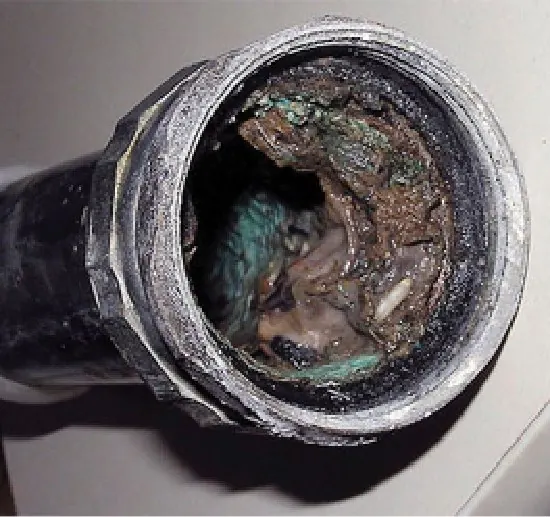
BIOFILM
This layer of organic matter lining the inside of the water distribution system elements can contain a high microbial load. The biofilm acts as a protective barrier for the microorganisms in the inner layers, making it difficult for disinfectants to gain access.
To achieve a high level of biosecurity in a farm, it is necessary to take into account not only the microbial load that the water brings from its origin, but also the risk of the possible existence of biofilm in the installation.
Chlorine DIOXIDE destroys the disulfide bridges that form in the biofilm, eliminating it and thus being able to act against the bacteria that are protected in it.
DIXCLOR
Fast, broad-spectrum active disinfectant for drinking water systems and surfaces.
DIXCLOR tablets, chlorine dioxide generators, have a high disinfectant capacity with a broad spectrum of action. They act by penetrating into the bacterial plasma membrane and attacking its RNA.
It is presented in the form of fast dissolving tablets in cold or hot water, and is effective in a wide range of water pH values (4-9), without modifying it.
DIXCLOR is very selective in its action, which allows its use at low doses and is active in waters with a high organic matter content. In addition, it prevents the formation of biofilm in water pipes and is compatible with medicines.
The advantage of this product is that it is easy to handle, which reduces risks for the people who handle it. In addition, it does not generate residues or toxic or corrosive by-products and is approved as a treatment for the sanitization of water for human consumption.
The tablets are easy to use, either directly in rafts or reservoirs, or with dosing equipment, and have a long life cycle, being easily stored for more than 2 years.

In overview
The characteristics that make chlorine dioxide anideal disinfectant for the sanitization of water in livestock farms are:
- Broad spectrum and high biocidal power
- Very selective action, which makes its use possible at very low doses
- Active in the presence of organic matter
- High efficacy against biofilm
- Activity in a wide range of ph (4-9)